


My mom recently sent me an old photo of myself as a kid.
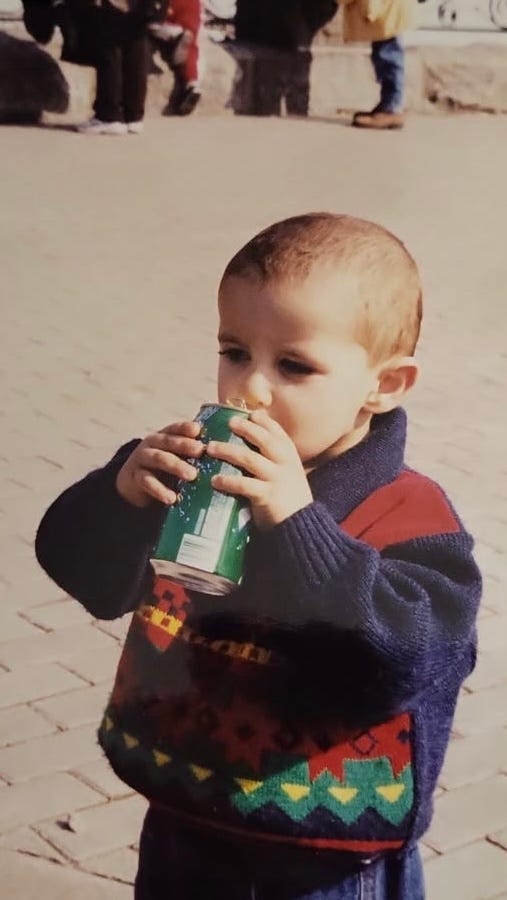
My first reaction was the one anyone has to the sight of a small child: I loved him and I wanted to protect him. It didn’t occur to me to ask what he had done to deserve that. He was a kid, and a kid’s worth doesn't depend on anything he does.
Then the obvious fact hit me: that kid is me. I’m the same person, grown, and for most of my life I’ve refused myself the verdict I gave him without thinking. So why did I believe that the grown version had to earn the same love and protection?
I paid for my worth in achievements
Like a lot of high achievers, I’ve struggled with low self-worth for as long as I can remember, and that struggle is where most of my drive came from. I set a goal and work toward it until I hit it. And for a very short while afterward I feel like I’ve earned my place. Then the feeling fades, and the only way I know to get it back is a new, bigger goal.
I remember the first time I benched 225 lb, or the first time I landed a six-figure job. These felt great in the moment, but shortly after I needed something else. By the next day the new targets were set: a 315 lb bench and seven figures a year.
Wanting to achieve things is healthy, and I still want to. The problem was where the wanting came from. I didn’t achieve in spite of low self-worth. I achieved because of it. Every goal I reached proved I was good enough for that goal, and the proof expired once I set the next one.
Psychologists call this contingent self-worth: self-esteem that rises and falls with how you do in whatever you've staked yourself on. Jennifer Crocker’s research on university students found that the ones who based their worth on grades felt bigger swings with each result, and didn’t earn better grades for it.
For many people, that stake is their job, or how much their partner seems to love them that day. Either way, your mood depends on someone else's verdict, and it changes whenever theirs does. How can you call yourself free when your worth is set each day by peers and partners?
In code, a loop exits when its condition becomes true. If the condition moves every time you get close, the loop never terminates, however fast each iteration runs. Feeling worthy was my exit condition, and each goal I reached moved it one goal further. It was always when I get this, or when I achieve that. Running the loop harder only produced more iterations.
What would change if the worth came first?
Worth has to come first
In the reversed order, you start out feeling worthy, and because of that you trust you’re able to go after what you want. Confidence comes from the worth, and achievement comes from the confidence.
The difference shows up the first time something fails. In the old loop, a missed goal counts as evidence against you, so every attempt puts your worth at stake. That makes hard attempts expensive, and it makes quitting early look sensible. When your worth is settled before you start, a failure costs you the attempt and nothing else. You can take on something harder, miss, and try again.
Knowing the right order is one thing. Feeling it is another.
The kid never had to earn it
The photo gave me that order. When I looked at that kid, I didn’t check what he’d accomplished. He hadn’t accomplished anything yet, and it made no difference. The verdict came first, before any evidence, which is the order I’d been failing to build for myself.
And that kid is me, at an age when I had achieved nothing. The worth I saw in him on sight was already there before any of my achievements existed. Nothing I’ve done since added to it, and no goal I miss can take it away.
One photo won’t shut down a loop that has run for most of my life, and I don’t expect it to. What changed is that I’ve seen the verdict I kept chasing, when it was already mine, long before I’d done anything.
If anyone told that kid he had to earn his place, I’d want to stand between him and that person. For most of my life, the one telling him was me.
When I see that picture, I want to hold him and tell him that I love him unconditionally. I want to make him smile and giggle just to see him happy. Because he’s a kid… because he deserves it.
I still want the goals. I want to go after them the way I’d want him to, already sure he’s enough before he starts.
That kid is me. I am worthy.
"If anyone told that kid he had to earn his place, I’d want to stand between him and that person. For most of my life, the one telling him was me." Insanely powerful line brother. I really like the passage about worth having to come first in reverse order.
You were worthy then, and you are worthy now, without ever having to prove a thing. This was truly beautiful and powerful to read ❤️